How much does condo insurance cost? 2026 averages by state

Condo insurance costs less than a homeowners policy because it covers the inside of your unit and your belongings, not the building structure. But “less” is relative. What you actually pay depends on where you live, what coverage you choose, your deductible, and what your HOA’s master policy already handles.
Here's what condo insurance costs in 2026, what moves your premium up or down, and how to compare quotes line by line.
Key takeaways
- Condo insurance costs less than a homeowners policy—that’s because your HOA's master policy already insures the building
- Nationally, condo owners typically pay between $200 and $1,400 a year—with your state doing most of the work in that range
- Your location moves your premium more than anything else —wind, hail, hurricane, and wildfire risks are all priced in
- Your HOA's master policy type sets how much dwelling coverage you need an all-in policy usually means you can carry less
- Your deductible is the most direct way to lower your premium—as long as you raise it to an amount you could absorb after a loss
Quick answer: average condo insurance cost in 2026
Condo insurance (HO-6) typically costs less than a standard homeowners policy because it doesn't cover the building structure. That part generally falls to your HOA’s master policy.
Nationally, condo owners typically pay between $200 and $1,400 a year, depending on your state, coverage limits, deductible, and the type of master policy your HOA carries. The factors that move your price most are location risk, how much personal property coverage you choose, and how much interior dwelling coverage you carry based on your HOA's policy type.
What HO-6 condo insurance is (and what the price reflects)
An HO-6 policy is the standard insurance form for condo unit owners. It typically covers your personal belongings, personal liability, loss of use (temporary living expenses if your condo is uninhabitable after a covered loss), and the parts of your unit you’re responsible for insuring, including interior finishes and upgrades. It doesn’t cover the building shell, roof, or shared common areas, because those are insured under your HOA’s master policy.
Your premium reflects the coverage you’re actually buying: interior dwelling coverage (if your HOA policy is “bare walls” type), personal property, liability, and any add-ons you choose. Because there is no building structure to cover, the starting cost is lower than a comparable homeowners policy, but your personal choices still affect the final number.
Why the master policy matters for your cost
Your HOA’s master policy type directly affects how much interior dwelling coverage you need to carry, and therefore what you pay.
- A “bare walls” master policy covers only the building shell, leaving interior walls, flooring, and fixtures to you.
- A “single entity” policy may cover original fixtures.
- An “all-in” policy covers both original and upgraded fixtures.
If your HOA carries an all-in policy, you may need less dwelling coverage on your HO-6, which can reduce your premium. Ask your HOA for the master policy declarations page before choosing your Coverage A limit.
Average condo insurance cost by state (2026)
The table below shows estimated average annual HO-6 premiums by state for 2026, based on a typical coverage setup: $60,000 personal property (replacement cost), $300,000 liability, $1,000 all-peril deductible, with basic interior dwelling coverage. These are estimates. Use them as a starting benchmark, not a final price.
Average Condo Insurance Cost by State (2026), Illustrative Estimated Ranges
State | Est. Annual Premium | Est. Monthly | Key Cost Drivers |
|---|---|---|---|
Alabama | $320-$520 | $27-$43 | Wind/hail, tornado risk |
Alaska | $250-$400 | $21-$33 | Lower density, earthquake risk varies |
Arizona | $200-$380 | $17-$32 | Lower rain/hail risk |
California | $320-$600 | $27-$50 | Wildfire risk, rebuild costs |
Colorado | $280-$480 | $23-$40 | Hail, wildfire risk increasing |
Connecticut | $260-$440 | $22-$37 | Northeast weather, higher rebuild costs |
Florida | $600-$1,400 | $50-$117 | Hurricane, wind/hail, high claim frequency |
Georgia | $300-$520 | $25-$43 | Wind/hail, tornado risk |
Hawaii | $300-$550 | $25-$46 | Hurricane, high rebuild costs |
Illinois | $250-$420 | $21-$35 | Midwest storms, tornado risk |
Louisiana | $500-$1,100 | $42-$92 | Hurricane exposure, high claim history |
New York | $280-$520 | $23-$43 | High rebuild costs, urban density |
Texas | $380-$780 | $32-$65 | Wind/hail, severe weather frequency |
Washington | $220-$380 | $18-$32 | Lower weather risk, higher rebuild costs |
All other states | $200-$450 | $17-$38 | Varies by location, building, coverage |
Actual premiums may vary significantly based on your specific unit, coverage choices, claims history, and insurer.
Methodology note: Figures above are illustrative estimated ranges based on publicly available industry data and insurer rate filings. Actual premiums vary by unit details, coverage selections, deductible, insurer underwriting, and claims history. These figures reflect HO-6 contents-plus-liability coverage with modest interior dwelling coverage.
What affects condo insurance costs?
Condo insurance pricing is shaped by several factors—some you can control and some you can’t. Understanding them helps you shop smarter and choose coverage that fits your actual risk rather than overbuying or underbuying.
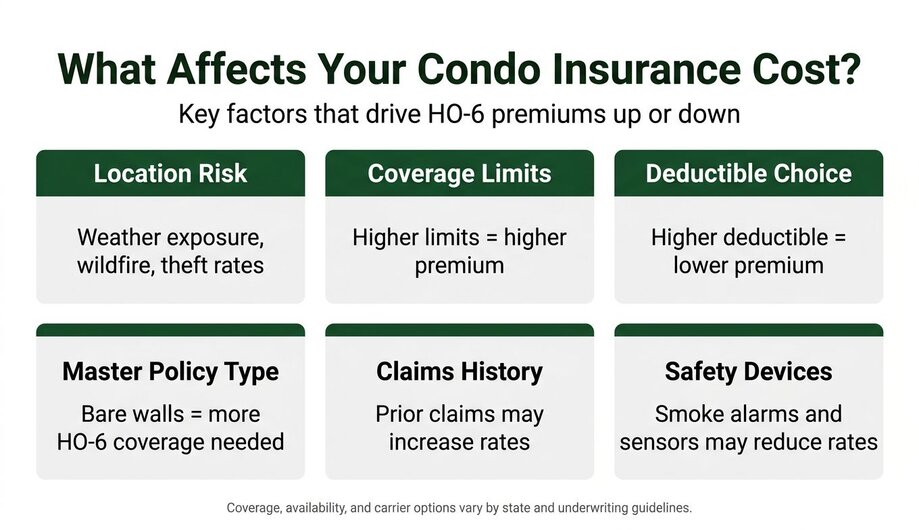
Location risk (wind, hail, wildfire, theft)
Where your condo is located is typically your largest cost variable. States and counties with higher risk of hurricanes, wind/hail storms, wildfires, or theft tend to carry higher HO-6 rates. Florida and Louisiana tend to sit at the top of the national range because of hurricane risk and claim history. Interior states with less severe weather usually see lower base rates. Local theft rates and your distance from the nearest fire station factor in as well.
Coverage amounts (personal property, dwelling, liability)
The limits you choose for personal property (Coverage C), interior dwelling (Coverage A), and personal liability (Coverage E) directly affect your premium. More coverage means a higher premium.
Choosing replacement cost value for personal property rather than actual cash value will also increase the cost, but it means you receive enough to buy a new item after a loss, rather than receiving a depreciated payout. If you want a refresher, see actual cash value vs replacement cost.
As far as liability goes, raising your limit above $300,000 usually adds less to your premium than owners expect. Ask your insurer what the step up costs.
Deductibles and endorsements
Your deductible is what you pay out of pocket before your insurance pays. It moves in the opposite direction from your premium. A higher deductible lowers your annual cost; a lower deductible raises it.
In hurricane and wind-prone states, some policies carry separate wind or hail deductibles that are a percentage of your coverage amount rather than a flat dollar figure.
Endorsements are add-ons that insure a risk your base policy leaves out. For example, endorsements like water backup, scheduled personal property, and identity theft protection each add to your premium, and each one closes a specific gap.
Claims history and credit-based insurance score (where permitted)
Prior claims can raise your premium, particularly if you’ve filed multiple claims in a short period. A lapse in prior coverage can also increase your rate with some carriers.
In states where it’s permitted, insurers may use a credit-based insurance score as a pricing factor—separate from your credit score but influenced by similar data. California prohibits the use of credit-based scores in property insurance pricing, so this depends on where you live.
Unit characteristics and building age
The age and construction of your building, the size of your unit, any recent renovations you’ve made, and safety features (smoke alarms, sprinklers, smart water leak detectors) can all influence pricing. Newer buildings with modern electrical, plumbing, and fire suppression systems may qualify for lower rates. Safety devices and smart home technology may qualify you for discounts with some insurers, though availability and savings amounts vary.
How to lower your condo insurance premium (without underinsuring)
Lowering your premium isn't about buying less protection than you need. It's about cutting what you don't need and keeping what you do.
Right-size coverage using your HOA master policy
Request the master policy declarations page from your HOA. If the policy is “all-in,” you may need less interior dwelling coverage on your HO-6. If it’s a “bare walls” policy, you’ll need more. Match your Coverage A to what you’re actually responsible for. Insuring what your HOA already insures is money you don't need to spend.
Raise your deductible strategically
Raising your deductible from $500 to $1,000 or $2,500 can lower your annual premium. The tradeoff is that you’ll pay more out of pocket if you file a claim. And only raise your deductible to an amount you could realistically afford after a loss. If you have a solid emergency fund, a higher deductible is usually your most direct way to lower your annual cost.
Bundle condo and auto insurance where available
Many insurers offer a multi-policy discount when you bundle condo and auto insurance together. Availability and savings vary by insurer and state, so it’s worth asking about this when comparing quotes. Bundling also keeps your policies with one company, which is one less thing to track.
Ask about safety device and smart home discounts
Smoke detectors, water leak sensors, smart security systems, and other safety devices may qualify you for premium discounts with some carriers. Tell your insurer about any safety devices you’ve installed when you get a quote.
How much condo insurance do you actually need?
Knowing the average cost is only useful if you’re shopping for coverage that fits your unit.
Start with your HOA master policy
Request the master policy declarations page and identify whether it’s bare walls, single entity, or all-in. This tells you what you’re responsible for covering with your HO-6 Coverage A.
Also note the master policy’s deductible. Large deductibles (especially percentage-based wind deductibles) can result in assessments to unit owners after a major loss, which makes loss assessment coverage (the add-on that pays your share of a large HOA bill after a major loss) worth considering.
Do a personal property inventory
Walk through your unit category by category (furniture, electronics, clothing, kitchen items, sports gear, and valuables) and estimate what it would cost to replace everything at today’s prices. This gives you a realistic Coverage C limit. Many condo owners underestimate their belongings until they walk through this exercise.
If you own high-value jewelry, art, cameras, or musical instruments, list those items separately on your policy—sometimes called “scheduling”—since base policies usually cap what they’ll pay for valuables, often at a few thousand dollars per category.
Choose liability limits based on your risk
Condo owners typically start at $300,000 in personal liability. If you have meaningful savings, investments, or other assets to protect, carrying $500,000 or more, or adding an umbrella policy, is worth pricing out
Condo insurance cost scenarios
Here's how different coverage choices play out across three profiles:
Scenario 1: Newer condo, moderate coverage, higher deductible
A condo owner in an interior state with a 10-year-old building, $50,000 in personal property (replacement cost), $200,000 dwelling, $300,000 liability, and a $2,500 deductible might pay toward the lower end of their state’s range, potentially $200-$350 annually in a lower-risk state. This profile benefits from a newer building, a manageable master policy gap, and a higher deductible reducing premium cost.
Scenario 2: Coastal location, maximum coverage, lower deductible
A condo owner in a coastal Florida county with a building exposed to hurricane and wind/hail risk, carrying $80,000 in personal property (replacement cost), $150,000 dwelling, $300,000 liability, a $500 all-peril deductible, and a separate 2% wind deductible, might pay toward the higher end of the state range—potentially $900-$1,300 annually.
The coastal location adds wind exposure pricing, the lower deductible increases the base premium, and the higher personal property limit reflects a fully furnished unit. Loss assessment coverage adds a modest additional cost but provides meaningful protection given the building’s hurricane exposure.
Scenario 3: High-value unit, scheduled property, umbrella liability
A condo owner in a metropolitan area with high-end finishes in a building with an all-in master policy, carrying $120,000 in personal property (replacement cost), $60,000 dwelling (reduced because the HOA covers original fixtures), $500,000 liability, and scheduled coverage for jewelry and art, might pay $500-$750 annually in a moderate-risk state. The scheduled items add cost but prevent sub-limit gaps on high-value belongings. The all-in master policy reduced the dwelling coverage needed, partially offsetting the higher liability and scheduled property premiums.
How to compare quotes (and what to ask)
Getting an accurate quote requires more than entering a zip code. How you set up your coverage directly affects your quote.
Apples-to-apples checklist
When you’re comparing quotes across carriers, always use the same variables:
- Identical dwelling (Coverage A) limits
- The same personal property (Coverage C) limits and valuation method (replacement cost vs. actual cash value)
- Identical liability (Coverage E) limits,
- The same deductible
Also confirm whether water backup, loss assessment, and scheduled personal property are included or priced separately. A policy that looks less expensive may be missing endorsements the others include, so compare the policies line by line, not just the premium.
What to verify in the exclusions
Before finalizing a policy, check what’s excluded. Most HO-6 policies don't cover:
- Flood damage—it usually requires a separate flood policy
- Earthquake damage—in most states it needs an endorsement or policy of its own
- Gradual damage—from mold or a long-term leak, for example
H0-6 policies also cap what they pay for jewelry, electronics, and cash. Those caps are called sub-limits. So remember to ask your insurer what specific perils are excluded and whether any endorsements are available to fill those gaps.
When a lower price may cost more later
A lower premium doesn’t always mean a better deal.
A policy with actual cash value rather than replacement cost for personal property will pay you less after a loss—since it pays the depreciated value of your belongings rather than the cost to replace them.
And policy with very low liability limits saves a few dollars a year, but leaves you exposed if someone sues you.
So be sure to ask your agent about valuation methods, liability sub-limits, and endorsement availability before choosing a policy on price alone.
Why get a quote with Hippo
Hippo helps make home insurance easy. Through our network of 70+ trusted carriers, we’ll find you the best quote and coverage options available. Get a free quote in about 60 seconds at hippo.com.
Coverage, availability, and carrier options vary by state and underwriting guidelines.
This article is for informational purposes only and was compiled from sources not affiliated with Hippo. While we believe this information to be reliable, we do not guarantee its accuracy or completeness. For any insurance-related decision, please consult your licensed insurance producer.
Sources cited are publicly available and referenced in August, 2026.